RSS Feed

Category Archives: Healthier Me

Meal Planning and Preparation

Posted on

Considering that the overall goal for this month is getting on a regular schedule, I have to take my eating habits into consideration too. One of the things that contributes, for better and worse, to what and when I eat is the amount of meal planning and preparation that I do. This is something I’ve been doing for a very long time, even before I was diagnosed, but the reason for doing it have gone beyond a less stressful day to eating healthy and well balanced – it’s become more important to my well-being over time.

A little background on Cushing’s Syndrome, it causes your body to create excess cortisol, which naturally causes the body to store more fat, typically around your midsection. Most people with Cushing’s have not only an increase in belly fat but also in odder areas; upper back and face are the most common. As a result of the excess fat storage you also gain quite a bit of weight, in the four months before diagnosis I gained forty pounds. One of the first things you should do is get together with a nutritionist and come up with strategies to at the very least slowdown that steady gain. My target was to not gain more than 10 pounds in that first year and I’m happy to say that I maintained that rate for the last three years up until I fell off the wagon last month and popped up a full twenty pounds in just 5 weeks.

Not an awesome disease but manageable if you have discipline.

For the duration, I’ve had some pretty simple dietary requirements; I’m a vegetarian so my protein can’t come from meat, my calorie limit is 2000 per day, I eat a limited amount of processed foods, sugar and dairy, and only get one cheat meal a week. With those guidelines, it is easy to come up with meal plans that are healthy and adhere to my no prep stress desires.

Every Saturday, I sit down to plan out the week – three meals and three snacks per day – pull together a grocery list and update my tracking software with any new recipes or ingredients. I tend to keep things simple and eat the same meals/snacks over the week, especially my breakfast. As you can see from the image below it’s very straight forward.
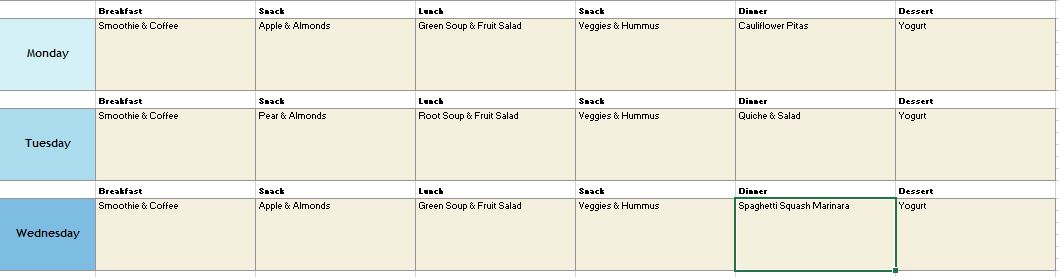
menu-plan

On Sundays I actually do the meal preparations, this entails taking of all the ingredients that I need for breakfast, lunch and snacks and doing whatever preparation needs to happen and then packaging them all up. This usually takes an hour or two depending on the cooking involved. My dinners have come from Blue Apron for the last year so I’ve effectively outsourced much of the prep work there.

Aside from the health aspects, the biggest benefit that I gain by doing things this way is that when I get up in the morning, my food for the day is already ready to go. I bag it all, mix my smoothie and grab my coffee and I’m out the door in less than 10 minutes. It does also prevent me from making bad choices for lunch or worse skipping lunch all together, and keeps my blood sugar and energy at a consistent level all day long. I think, for me, it is well worth the sacrifice of couple of hours of time in order to make this happen.

For me the biggest barrier was making the commitment to get it going. Making sure I have all the ingredients and containers to pull it off came through a lot of trial and error but once you get through a couple of weeks you’re pretty much set. I do mix things up over the year as the seasons change, more soups in the winter and more salads in the summer. If you don’t I think it’s pretty easy to get bored. And occasionally your taste buds will need a little reboot.

If you want to give it a shot, I recommend any containers made by Sistema. They are durable, convenient and often come with utensils.

Shabbas – Empathy

Posted on

One of my readings this week was on empathy, not just caring for others but doing so even when you’re inconvenienced in the process. Those moments when you have to pull over for a siren, or you have to sit in traffic and wait for an accident to clear or even when an appointment is cancelled or postponed for someone else emergency.  It’s pretty easy, I think, to focus on how those things impact you and dwell there a bit but taking a moment to sit and ponder the person or persons on the other end… that’s an entirely different perspective.

If there are sirens then that might mean someone is hurt or in a dangerous situation and needs help.

A few extra minutes in traffic for me over a crunched car, a ticket or injury?

The minor inconvenience of waiting when the other person might have suffered a loss or is having a really bad day.

Following these thoughts through I’ve decided that I am going to take those moments to hope someone gets help in time, that their day gets better or just to wish them well instead of moaning over a few lost minutes in my day.

Keeping Shabbat

Posted on

Shabbat is probably the most difficult mitzvah for me to write about much less practice. However, it is the most important ritual mitzvah, and therefore worthy of further contemplation.  Conceptually it is also perhaps the most spiritually valuable mitzvah: all individuals are relieved of the labors of everyday life, you have the opportunity to contemplate the spiritual aspects of life and can spend time with family and friends. Unfortunately it also happens to involve some of the most difficult restrictions of any observance or festival days in Judaism. Those restrictions are split into two commandments: to observe or Shamor and to remember or Zakhor.

I find it especially difficult to fulfill the first commandment to guard or observe. I take issue with some of the precepts surrounding the term guard; you can’t grow or prepare food, you can’t create or build, you can’t handle objects that are used during the week for work, you aren’t allowed to do things that are not in the spirit of the day or rather are weekday in spirit. When I kept Shabbat, based upon those restrictions, I did next to nothing from the time I lit the candles on Fri night to when the sun went down on Saturday. Arguably, being a sloth for close to 24 hours can be excellent for your well being. I’d spend a lot of time reading, playing and resting, and those are all good things, but I’d often not eat, rarely having the presence of mind to prepare food ahead of time. I’d also stay in the house, at times not even dressing until late Saturday for Havdalah. The net effect of all of those things was by Saturday evening I was lethargic and dreading all the things I’d need to do on Sunday to get ready for the week; not some super meditative state where I’d reinter the week feeling all relaxed and energized. After a few months of struggle, I took it upon myself to reinvent the practice to better fit my lifestyle.

You can’t grow or prepare food: The literal translation of this one is impossible and you need to eat to maintain your blood sugar and maintain all those positive vibes (Cranky is definitely un-Shabbat). My somewhat lame attempt to try to follow this restriction is that I try to not actually cook but I do at the very least prepare food.

You can’t create or build: I’ve added to this my own little disclaimer-for profit. I don’t do any work and will not do work that is for monetary gain – no matter what. However, I will create because I do enjoy the feelings you gain from indulging in a pursuit that brings you happiness.

You can’t handle objects that are used during the week for work: for me that is my computer and my phone. Sorry, that’s not happening but I do limit myself to enriching activities and nothing at all work related.

You aren’t allowed to do things that are not in the spirit of the day: Well, I agree that you should never ask people to do your work for you.  So this one is relatively simple for me given the disclaimer I added above.

You aren’t allowed to do things that are weekday in spirit: I try not to talk, think, plan, rehash, or dwell on my work week at all. I take some time pre-Shabbat, Friday afternoons to let go of all of that mess and start Shabbat with a clean heart and an open mind.

The other aspect of Shabbat is reflection: There are all kinds of rituals that are special to Shabbat and all are designed to remember the day; the lighting of the candles, eating challah and prayers on Friday evenings, to the family meals and the ritual of Havdalah on Saturday. While I don’t often perform the specific rituals I do translate their significance to whatever activity that I do.

I do wholeheartedly believe that the concept of Shabbat as a method to break up the separate segments of your existence is an excellent idea. Take a simple break from your work life, reflect for a day and do whatever it is that makes you happy and relaxed. Enjoy your time and be aware of all that is good in your life. Simply appreciate what you have and the opportunity to be.


January 2017 Goals – Getting on a Schedule

Posted on

Well I would like to firmly say that I accomplished my goal in October to start the new year off with a set of life affirming habits but not entirely. Between work and some lovely surgical side effects, I’ve been in maintenance mode, just focusing on getting through the day to day. When I looked back on that post in the process of setting my goals and resolutions for 2017, I realized that I have at least settled on the habits that I feel I need to either make a priority or get in place – things that I should be doing regularly, either on a daily, weekly or monthly basis

Which brings me to January.

This month my goals is simply to get my schedule under control, finding the time I need to do those habits that positively support my goals.

For health, the one thing that I really miss the most about my life since my Cushing’s diagnosis is running. Running every day just got painful as I got heavier and once I stopped my stamina took a nose dive. I picked up a slow start program off of the Runner’s World site that focuses on deliberate progression from walking to running in about 21 weeks. That combined with all of the other activities on my list should help me ease back into running without injury. I’d like to say that it’ll help me get the weight off but I don’t think I’m there yet, at least it’ll halt the gaining (I’m up about 18 pounds since my surgery in late September).

Relationships are a little more difficult to tie directly to a specific habit, I’m thinking that is really more pf a priority shift, spending more quality time with the folks’ I am closest to, making room for new activities and connections and taking time to make sure everyone in my life knows how much I appreciate them.

Creativity, I’m a little ashamed to say, has been put on the schedule. I know if I don’t make the time for it, it just isn’t going to happen. It’s not spontaneous at all but I am going for habits. I have a couple of nights a week to work the craft projects, regular time than I’ve blocked off to spend on writing and some ‘free’ blocks that I hope will turn into more focused expression times… where I can go with my mood or inspirations.

I used to be so tied to my calendar, if it didn’t make it on their it just didn’t get done, and was very disciplined about sticking to it. This last couple of months, I shifted over to just having a to do list and have found that I’m far more likely to put things off that way, or start procrastinating.

So, there you have it, my only real goal for January is to stick to my schedule with priorities in place should I have a conflict. Easy enough!

Meditation – Benefits and Practice

Posted on

About six years ago I was introduced to the benefits of meditation by a book called Undoing Perpetual Stress by Richard O’Connor Ph.D.  In the book he outlines all of the physiological things that happen to your body when you’re under continual stress, the psychological habits and/or issues that contribute to the stress response and a number of different ways to combat stress or lessen it on regular basis.  Having had some experience with meditation during yoga classes, I decided to test out different types of meditation and see what I could incorporate into my daily life.

The numbers of physiological and psychological benefits of meditation are astounding. Physiologically, the most important of which include those that directly contribute to the reduction of stress: decreases in muscle tension, reductions in anxiety and blood pressure as well as an increase in blood flow (more oxygen!). There is also some evidence that meditation can help with PMS and with healing after injuries and operations. The research currently being done on the impact to disease processes and weight loss are also very compelling. On the psychological side meditation research has focused on the level of way in which it makes you feel better: resolving your phobias and fears, increased relaxation and better focus in your daily activities. Some people even use meditation to assist them with quitting smoking and other addiction issues.

So what is meditation? The definition is pretty simple – short regular periods spent in deep thought, prayer or calming the mind. I like this short video by Eckhart Tolle describing the meaning of meditation as just being in the present moment – experiencing the now with all of your senses. There are as many different ways to meditate as there are different types of meditation practices out there; transcendental, chanting, mantras, sitting, walking, mindfulness and my favorite – yoga nidra.

I myself practice a number of different types depending on my mood and/or the benefit that I’m seeking.  My favorite meditation practice is yoga nidra, or yogic sleep, it is a process where through creative visualization you relax your body while your mind remains alert.  This one practice can take me in 20 minutes from being a nervous wreck to being calm, alert and re energized.  I use yoga nidra to combat sleeplessness, periods of high anxiety and migraines.

Last year, after a couple of years of working on a consistent practice, I decided to try Headspace as a refresher on the basics and to help work my way up to longer mediation times. I’m very happy with the content and the ease of using the application, and while I’m not quite there yet I do enjoy the structure having the guidance provides me. There are loads of apps, sites, books, audio, podcasts to help you get started, the trick is really just to try a few and settle on what you like best.